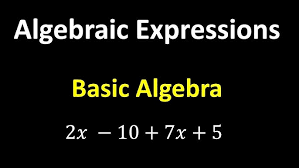
Lesson 1: Introduction to Algebraic Expressions
🎯 Learning Objectives
By the end of this lesson, students should be able to:
- Define algebra and algebraic expressions.
- Identify constants, variables, coefficients, and terms.
- Write algebraic expressions from verbal statements.
- Distinguish between like and unlike terms.
- Understand basic algebraic notation and symbols.
🧾 Explanatory Notes
- What is Algebra?
Algebra is a branch of mathematics that uses letters and symbols to represent numbers and quantities in formulas and equations. These letters are called variables because their values can change. - Basic Components of an Algebraic Expression
An algebraic expression is a combination of numbers, letters, and operation signs (such as +, −, ×, ÷).
Example:
[3x + 2y - 5]
Here:
- ( x ) and ( y ) are variables.
- 3 and 2 are coefficients (numbers multiplying the variables).
- −5 is a constant term.
- Terms in an Expression
Each separate part of an expression joined by + or − is a term.
Example: In ( 4a + 3b – 7 ), the terms are ( 4a, 3b, -7 ). - Like and Unlike Terms
- Like terms: Have the same variable(s) and power(s).
Example: ( 3x, 5x, -2x ) are like terms. - Unlike terms: Have different variables or powers.
Example: ( 3x, 4y, 2x^2 ).
- Writing Expressions from Words
To form algebraic expressions:
- “A number increased by 5” → ( x + 5 )
- “Twice a number” → ( 2x )
- “A number decreased by 7” → ( x - 7 )
- “The sum of a number and its square” → ( x + x^2 )
✍️ Worked Examples
Example 1:
Write an algebraic expression for: “Three more than twice a number.”
Solution:
Let the number be ( x ).
“Twice a number” → ( 2x ).
“Three more than twice a number” → ( 2x + 3 ).
Example 2:
Identify the coefficients, variables, and constants in ( 4x^2 - 3x + 7 ).
Solution:
- Coefficients: 4, −3
- Variables: ( x )
- Constant: 7
Example 3:
Simplify: ( 2x + 5y + 3x - 2y ).
Solution:
Combine like terms:
( (2x + 3x) + (5y - 2y) = 5x + 3y ).