Course Content
Transformation
This course introduces learners to geometric transformations and how shapes move or change on the coordinate plane. Students will explore the four main types of transformations—translation, reflection, rotation, and enlargement—learning how each affects the position, orientation, and size of shapes. Through clear explanations, guided examples, and practice activities, learners will develop the skills to identify, perform, and describe transformations confidently. This course builds spatial reasoning and prepares students for more advanced geometric concepts.
0/5
Transformation

A rotation turns a shape about a fixed point called the centre of rotation.

Default centre: (0, 0).


Rotation Rules (About the Origin)

Rotation

Mapping

90° anticlockwise

(x, y) → (−y, x)

90° clockwise

(x, y) → (y, −x)

180°

(x, y) → (−x, −y)

270° anticlockwise = 90° clockwise

(x, y) → (y, −x)


Worked Example 1

Rotate A(3,2) 90° anticlockwise about the origin.

New point: (−2, 3)


Worked Example 2

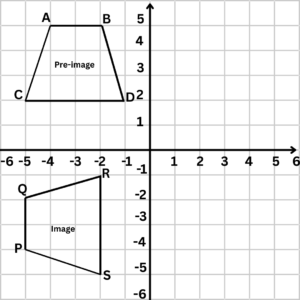
Rotate A(4,-5) , B(2,-5), C(5,-2) and D(4,-5) 90° about the origin in a clockwise direction.

New point: P(-5,-4) , Q(-5,-2), C(-2,-5) and D(-2,-1)